AI and HR techRecruiting and TA leadership
Everyone Wants Us Using AI. Is It Actually Helping?
If you work in corporate America right now, you’ve heard some version of this: “We need to be using AI.”
It comes from the top and from peers. It comes up in town halls and creeps into your goals. And every vendor wants to tell you about AI and why their newest release is the best.
Don’t get me wrong. I use Claude, Copilot and ChatGPT as much as the next person, and they help me. But is AI actually working for us professionally?
Some of these tools are genuinely useful. iCIMS, for example, rolled out a Hiring Agent that lets hiring managers review candidates, give feedback and approve hires right inside Microsoft Teams. That’s meeting managers where they already are.
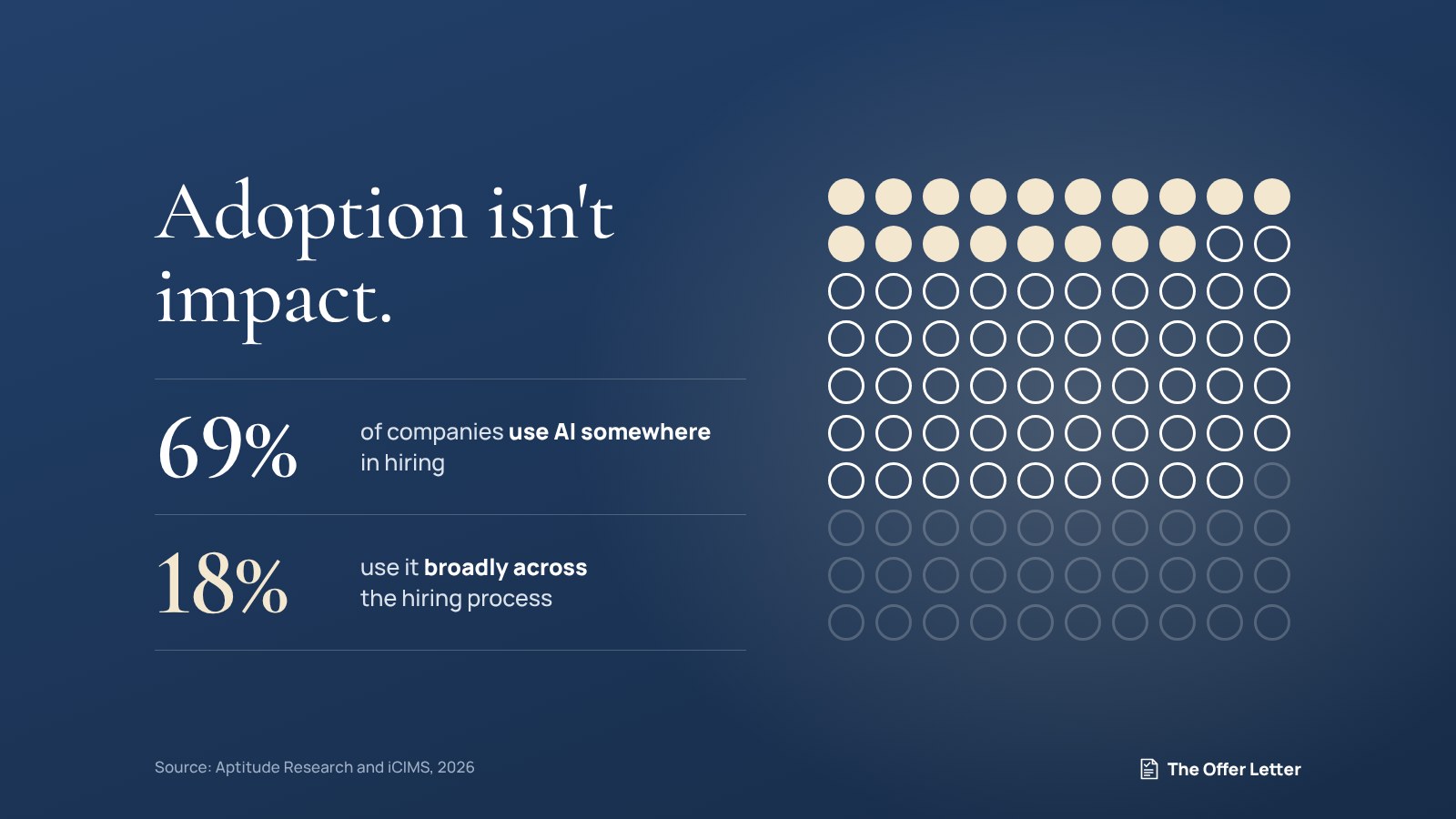
But adoption isn’t the same as impact. According to Aptitude Research and iCIMS, 69% of companies use AI in some capacity in hiring. Only 18% use it broadly across hiring. (If you don’t follow Aptitude Research, you should. They do great work.)
That’s a lot of teams adding AI while keeping every other process the same.
In a Gartner survey released in late 2025, 88% of HR leaders said their organizations hadn’t seen significant business value from AI yet. I read that as AI sitting on top of processes that weren’t built for it.
If your hiring process was slow and clunky in 2019, an AI layer won’t fix it. A bad process is still a bad process. So before you buy, ask: will AI solve this problem, or does something else need to change too?
Then there’s the candidate side. For its 2025 AI in Hiring report, Greenhouse surveyed about 2,900 job seekers across the US, UK, Ireland and Germany. Only 8% said AI makes hiring fairer. From my own experience, most candidates assume every company is using AI, and they feel like they’re trying to get past a system instead of reaching a person.
That’s where transparency comes in. Tell candidates where AI is part of your process and where a person makes the call. Keep a human in the loop on the decisions that matter, like who moves forward, who gets rejected and who gets an offer. AI can help us move faster and spot what we’d miss, but a person should own the outcome. Candidates don’t expect a process without AI. They expect honesty about how it’s used and a real person on the other side.
And transparency is quickly becoming the law, not just good practice. New York City already requires bias audits and candidate notice for automated hiring tools. Illinois now requires employers to tell applicants when AI is used in hiring decisions, on top of its rules for AI video interviews. Colorado’s new AI law, set to take effect in January 2027, goes further: notice up front, an explanation when AI plays a role in a rejection and a way to request human review. Enforcement is on hold for now while it’s challenged in federal court, but the direction is clear. Other states will follow.
I’m not anti-AI. Far from it. I embrace it and use it every day. It’s troubleshot problems for me, helped me spot patterns in data and helped me rebuild this site.
Right now I’m looking at a process that needs modernizing, and I’m weighing every option. Here’s what I’m asking:
- What time will it actually save? I’ve had people run time studies to find out.
- Does it improve the candidate experience? Take AI interviewing. In my industry, I don’t think candidates want to talk to a bot.
- What’s the net benefit of cleaning up the process first?
- Is this vendor the best fit on cost, integration and functionality?
- Where does a person stay in the loop, and how will we tell candidates AI is part of the process?
- Are Legal and InfoSec on board?
The goal isn’t to use AI. It’s to hire better.